Lucas seeks legal recourse against the pit bull classification
A Dog's Way HomeLucas’s effort to protect Bella from Denver’s pit bull classification turns a contested label into an immediate question of where she can safely go. After an animal-control officer calls her a pit bull and threatens impoundment, Lucas looks for a legal remedy and learns that neither Bella’s behavior nor her emotional-support letter can readily overturn the city’s process. His most practical protection is spatial: keep Bella inside the leased property and teach her to go home when an officer approaches.
Encounter and disputed classification
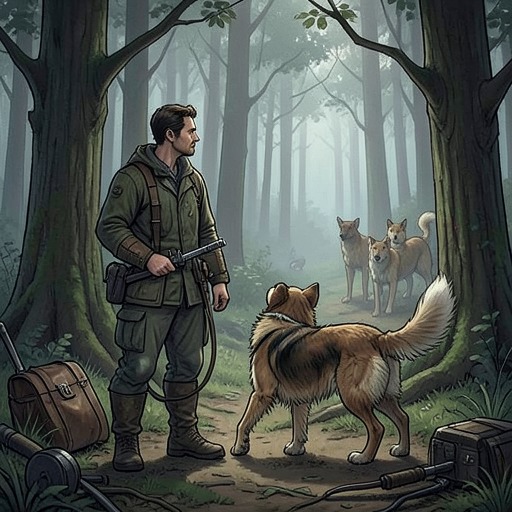
Returning from the park with Bella, Lucas encountered Gunter and an animal-control vehicle. An officer, identifiable to Bella by the animal smells on his clothes, called Lucas over to discuss his dog. Lucas instead gave Bella the Go Home command and ran with her toward the house, keeping her attached to the leash. Bella initially treated the run as an enjoyable variation of their familiar game, but the command’s purpose was to get her to her designated spot indoors. Lucas brought her inside and praised her for complying.
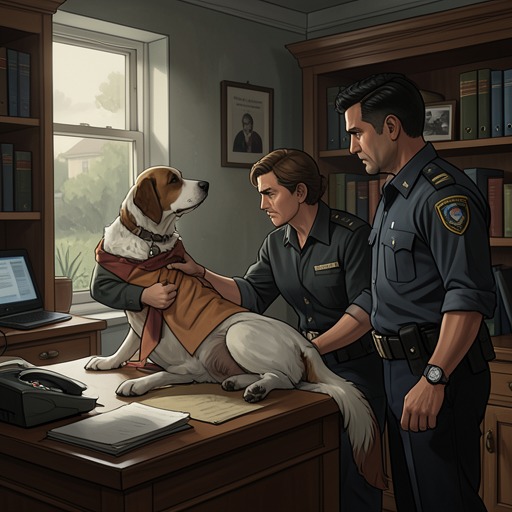
The exchange continued at the residence. The officer acknowledged that he could not enter a home to take Bella. When Lucas called her to his side, the officer emphatically declared her a pit bull. Lucas replied that they had a letter, referring to the doctor’s documentation that Bella provided emotional support to Terri. The officer then threw Bella a treat. She lunged for it, and he used that response to argue that she did not qualify as a therapy dog because she could not ignore food on the ground. He warned that if he caught her outside the apartment, he would impound her as an illegal breed.
The test exposed a consequential mismatch between the household’s understanding of the letter and the officer’s standard. Lucas and Terri relied on Bella’s emotional support and her demonstrated attentiveness to Terri; the officer treated the treat response as a failed therapy-dog test. Lucas challenged the implication that this settled the matter, but the officer’s point was that the city could act on its own classification. The scene therefore turns not on a definitive account of Bella’s ancestry, but on the authority attached to an officer’s label.
The legal limits Lucas discovers
Lucas and Olivia later discussed the problem with a man who explained how the Denver ban operated. As he described it, there was no specific American Kennel Club breed called a pit bull; the term grouped a class of dogs. He connected the city council’s ban to a child’s death attributed in press coverage to a pit bull, while also noting that testimony had challenged the idea that such dogs were more dangerous than other dogs. He added that dachshunds, in his view, bit people more often, and that the ban had not prevented pit bulls from becoming more popular in Denver.
Those broader arguments did not offer Bella protection. The adviser distinguished the animal’s actual identity from the official determination: the practical problem was that animal control said Bella was a pit bull. According to his account, one officer’s judgment could lead to her being picked up; if two additional officers agreed with the classification, the law treated her as a pit bull. The classification thus operated as a sequence of official decisions rather than a finding that Lucas could easily contest on the spot.
The doctor’s letter did not supply an exception to that process. The adviser said that the treat test was one of several methods animal-control officers could use and that failing any one of them was enough. There was no appeal within the animal-shelter system. Lucas could take the matter to court, but litigation would be expensive, and Bella would have to remain in the shelter while the case proceeded, potentially for months. The possible remedy therefore carried a cost measured not only in money but also in prolonged separation.
Home as a legal boundary
When Lucas asked what they could do if the officer might take Bella outside, the answer was that Denver’s rules left them little recourse against the classification itself. Olivia pressed on the limits of animal control’s access. The adviser clarified that officers needed a court order to enter Lucas and Terri’s property. He extended that protection to the front porch, driveway, and garage, provided those spaces were included in the lease.
Lucas turned that legal distinction into a household instruction. He told Bella that if the bad man came, she had to Go Home and remain in her spot. Bella wagged at him but could not understand why the game now carried such weight. The command that had just brought them safely indoors became a practical strategy: the threshold and the leased areas around the home were not merely familiar territory but the spaces where the family believed Bella could be protected from seizure.
The encounter offers no ruling that clears Bella’s classification, and the advice does not resolve the underlying dispute. Instead, it narrows the immediate objective from winning recognition for Bella to preventing an encounter in a place where the officer could impound her. Lucas’s response is consequently both legal and behavioral: he asks what boundaries the law recognizes, then relies on a command Bella already knows to keep her within them.
Later jurisdictional complication
The conflict over who could control Bella reappeared later at the VA hospital. When animal-control officers came there, Dr. Gann challenged their authority on the ground that the facility was federal property rather than part of the City of Denver. The officer answered that the department had been called to the facility repeatedly, and Dr. Gann questioned whether the hospital had summoned them that night. The exchange does not establish the final legal outcome, but it extends the earlier dispute: the reach of animal control depended not only on Bella’s classification, but also on the jurisdiction attached to the place where she was found.